Application-specific marking configurations validated against industry traceability standards. Each solution includes substrate characterization, parameter optimization, and verification protocol design.
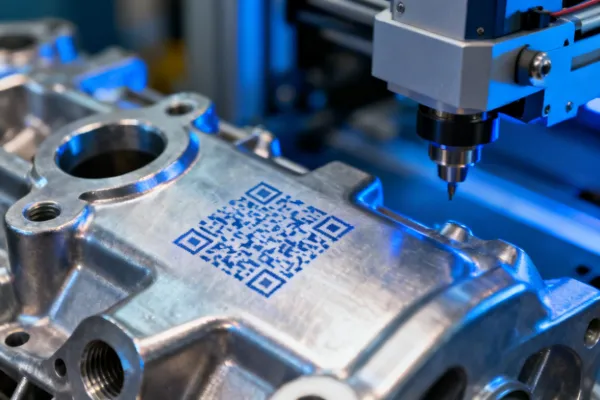
Automotive OEMs and Tier 1 suppliers face increasingly stringent traceability mandates. Our fiber laser marking systems produce permanent DataMatrix codes on engine blocks, transmission housings, brake calipers, and stamped sheet metal components that remain machine-readable after heat treatment, shot blasting, and e-coating processes.
Our applications team has validated marking parameters across 42 automotive-grade alloys, including A380 die-cast aluminum, 4140 alloy steel, and 304L stainless steel. Each parameter set is documented with a process capability study (Cpk) to support PPAP submissions.
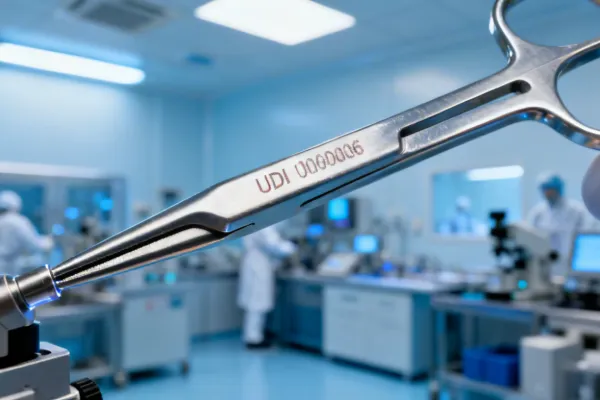
The FDA's Unique Device Identification rule requires permanent marking on reusable surgical instruments, implantable devices, and diagnostic equipment. Our UV and fiber laser systems produce corrosion-resistant marks on surgical stainless steels (17-4 PH, 316L) and titanium alloys (Ti-6Al-4V) that withstand repeated autoclave sterilization cycles at 134°C and 2.1 bar pressure.
Critically, our marking parameters are optimized to avoid chromium depletion in the heat-affected zone, which can compromise corrosion resistance in body-fluid environments. Independent testing by an accredited lab confirmed that our marked samples passed ASTM F2129 corrosion testing with no statistically significant degradation versus unmarked controls.
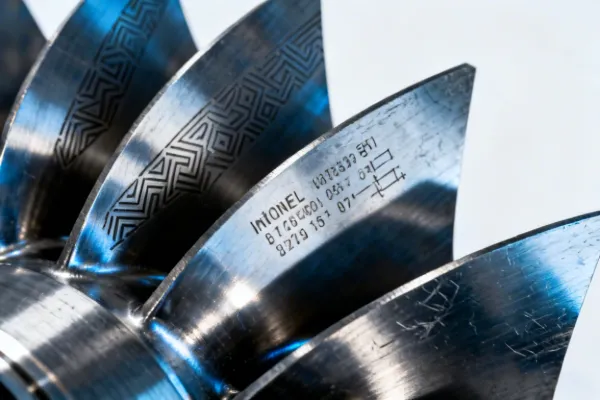
Aerospace traceability requirements demand permanent, human-readable and machine-readable marks on components that operate in extreme thermal and mechanical stress environments. Our systems mark Inconel 718, Waspaloy, and titanium alloy components with parameters specifically developed to minimize residual stress introduction.
We have validated marking depth control to within ±5 microns on nickel-based superalloys, which is critical for components where surface integrity directly affects fatigue life. Our parameter development process includes metallographic cross-section analysis to verify that marking depth and heat-affected zone dimensions meet the customer's engineering specification.
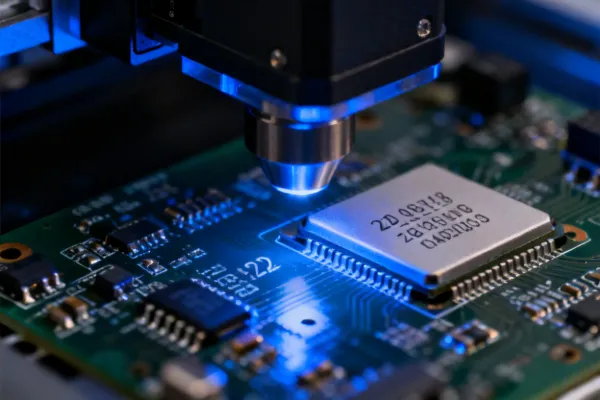
As electronic components shrink and board densities increase, traceability marking must occupy progressively smaller real estate without compromising readability. Our UV laser systems (355nm) achieve mark widths below 25 microns, enabling ISO/IEC 16022-compliant DataMatrix codes as small as 1mm x 1mm on FR-4, ceramic substrates, and molded IC packages.
The 355nm wavelength provides a fundamental advantage for heat-sensitive substrates: UV photons carry sufficient energy to break molecular bonds through photochemical ablation rather than thermal decomposition. This produces high-contrast marks on polyimide flex circuits and thin-film coatings without charring, delamination, or substrate warpage.
Our applications engineers have characterized marking parameters for over 340 material-substrate combinations. Send us your substrate and we will provide a complimentary feasibility assessment with documented results.
Submit Your Application for Review